Pour la réalisation du réseau, j’ai choisi d’utiliser la voie LGB code 332. Ce choix s’est imposé principalement parce que toute la gamme de voies est disponible, y compris un large choix d’aiguilles, ce qui facilite grandement la conception et l’évolution du tracé.
Il s’agit d’un standard très répandu dans le modélisme à cette échelle, ce qui présente un autre avantage important : on trouve facilement du matériel d’occasion. Cela permet d’agrandir ou de modifier le réseau progressivement sans dépendre uniquement du matériel neuf.
Les moteurs d’aiguille LGB sont également réputés pour leur robustesse et leur fiabilité, ce qui ne gâche rien lorsque l’on cherche un fonctionnement sûr et durable dans le temps.
J’avais également envisagé d’utiliser la voie Peco code 250, plus fine et plus réaliste visuellement. Cependant, au moment où j’ai commencé le réseau, le choix d’éléments de voie et d’aiguilles était plus limité, ce qui rendait la mise en œuvre plus contraignante pour le type de réseau que je souhaitais construire.
Le choix de la voie LGB relève donc d’un compromis entre réalisme, disponibilité du matériel, fiabilité des équipements et simplicité de mise en œuvre, en cohérence avec l’esprit général du projet.
Schéma du système de voie LGB – document constructeur (LGB / Märklin)
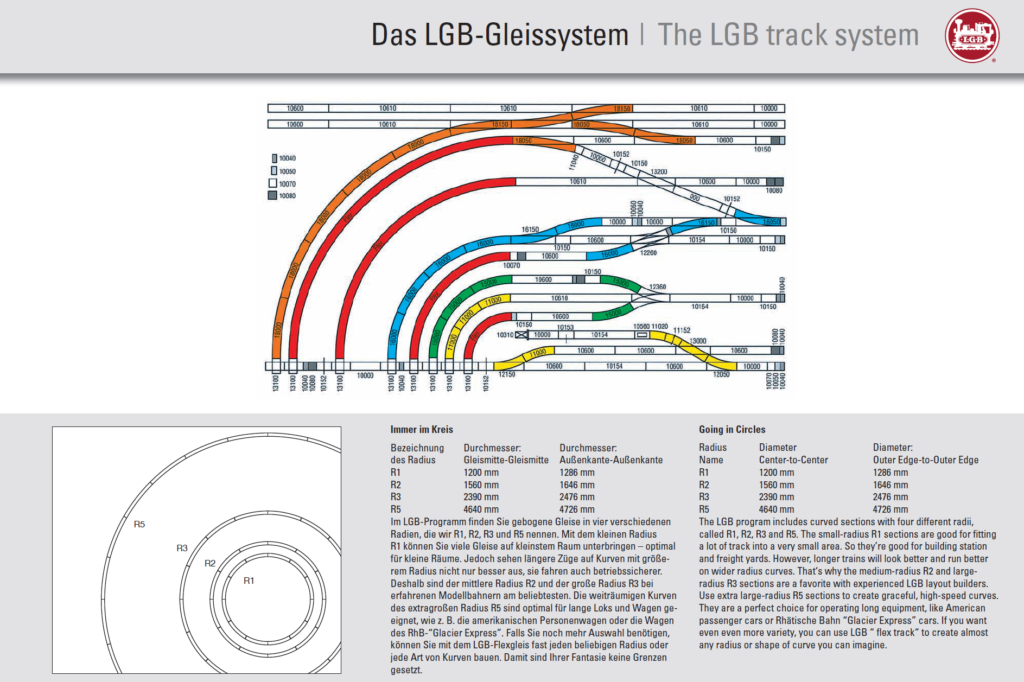
LGB track system diagram – manufacturer document (LGB / Märklin)
For the construction of the layout, I chose to use LGB code 332 track. This choice was mainly driven by the fact that the complete range of track elements is readily available, including a wide variety of turnouts, which greatly simplifies both the design and the future development of the track plan.
It is also a very common standard in this scale, which brings another important advantage: second-hand material is easy to find. This makes it possible to expand or modify the layout progressively without relying only on new components.
The LGB turnout motors are also well known for their robustness and reliability, which is a definite plus when aiming for dependable and long-term operation.
I also considered using Peco code 250 track, which is finer and visually more realistic. However, at the time I started building the layout, the range of available track elements and turnouts was more limited, making it less practical for the type of railway I wanted to build.
The choice of LGB track is therefore a compromise between realism, availability of components, equipment reliability, and ease of installation, in keeping with the overall spirit of the project.